
How to Track Progressive Overload in Strength Training
Progressive overload is the single most validated physiological principle in resistance training. Simply stated: to grow bigger and stronger muscles, you must subject your muscular and skeletal systems to progressively greater physical challenges over time.
However, many lifters equate progressive overload exclusively with slapping more weight onto the barbell. While adding weight is vital, it is only one of several distinct methods to achieve overload—and relying on it alone often leads to premature plateaus or compromised technique.
1. The Four Primary Methods of Progressive Overload
When tracking your workouts in GF Track, look for progression across these four distinct levers:
A. Increasing Resistance (Load)
The most direct form of overload: lifting heavier weight with identical repetitions and strict form. Example: Bench pressing 100kg for 8 reps → Bench pressing 102.5kg for 8 reps.
B. Increasing Repetitions (Volume)
Performing more reps with the same weight. This increases time under mechanical tension and total working tonnage. Example: Squatting 120kg for 6 reps → Squatting 120kg for 8 reps.
C. Increasing Sets (Total Training Volume)
Adding another working set to a movement to stimulate more motor units. Example: Performing 3 sets of 10 on Romanian Deadlifts → Performing 4 sets of 10.
D. Improving Execution Quality & Range of Motion
Completing the identical weight and reps with better control, a deeper stretch at the bottom, or reduced momentum. This increases internal muscular tension without altering external numbers.
2. Using the Double Progression Model
For natural lifters, the Double Progression Model is widely regarded as one of the most reliable and sustainable progression frameworks.
Here is how it works in practice:
- Pick a Target Rep Range: For example, 6 to 10 repetitions on the Dumbbell Incline Press.
- Choose a Starting Weight: Select a load you can lift for 6 clean reps (e.g. 30kg dumbbells).
- Progress Repetitions First: In successive workouts, keep the weight fixed at 30kg and aim to add reps to each set:
- Week 1: 30kg × 6, 6, 6
- Week 2: 30kg × 8, 7, 6
- Week 3: 30kg × 9, 8, 8
- Week 4: 30kg × 10, 10, 10
- Increase Weight When All Sets Top Out: Once you hit the top of the rep bracket (10 reps across all sets), increase the weight to 32.5kg and reset to the bottom of the rep range (6 reps).
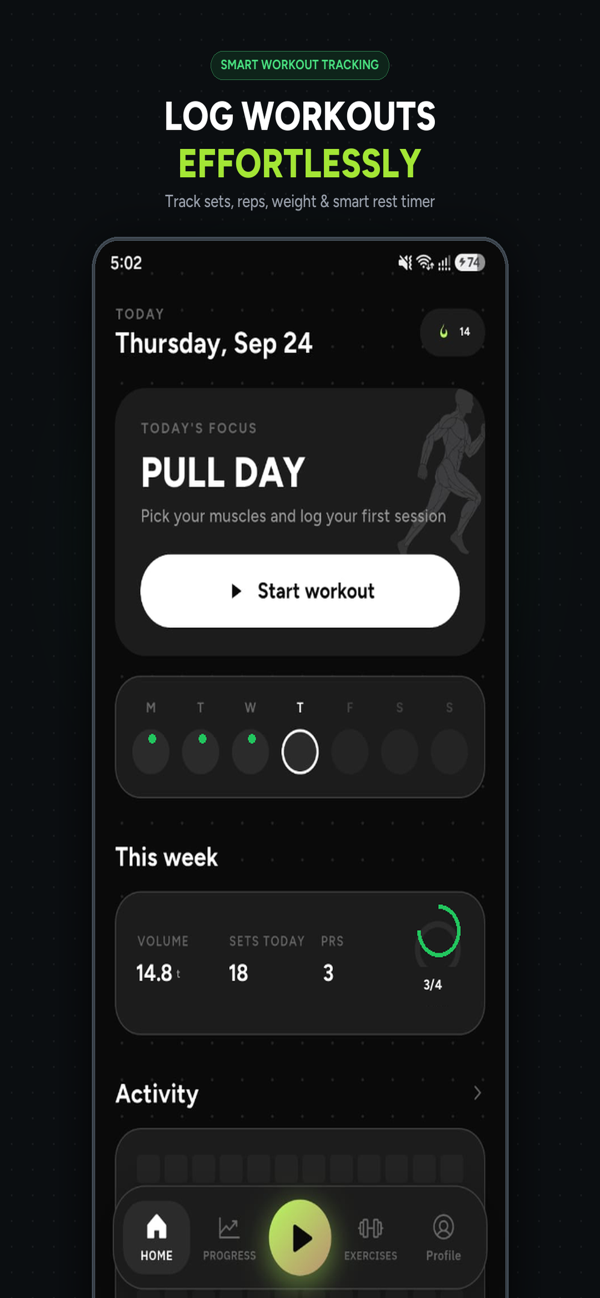
By using GF Track, you can record your exact sets in real time, and the app will remind you what numbers you completed during your prior workout so you know exactly when it’s time to move up in weight.
3. The Role of Tonnage & Volume Tracking
Total training volume is defined as:
$$\text{Volume (Tonnage)} = \text{Sets} \times \text{Reps} \times \text{Weight}$$
Tracking weekly volume per muscle group provides an objective metric to verify whether your workload is steadily expanding.
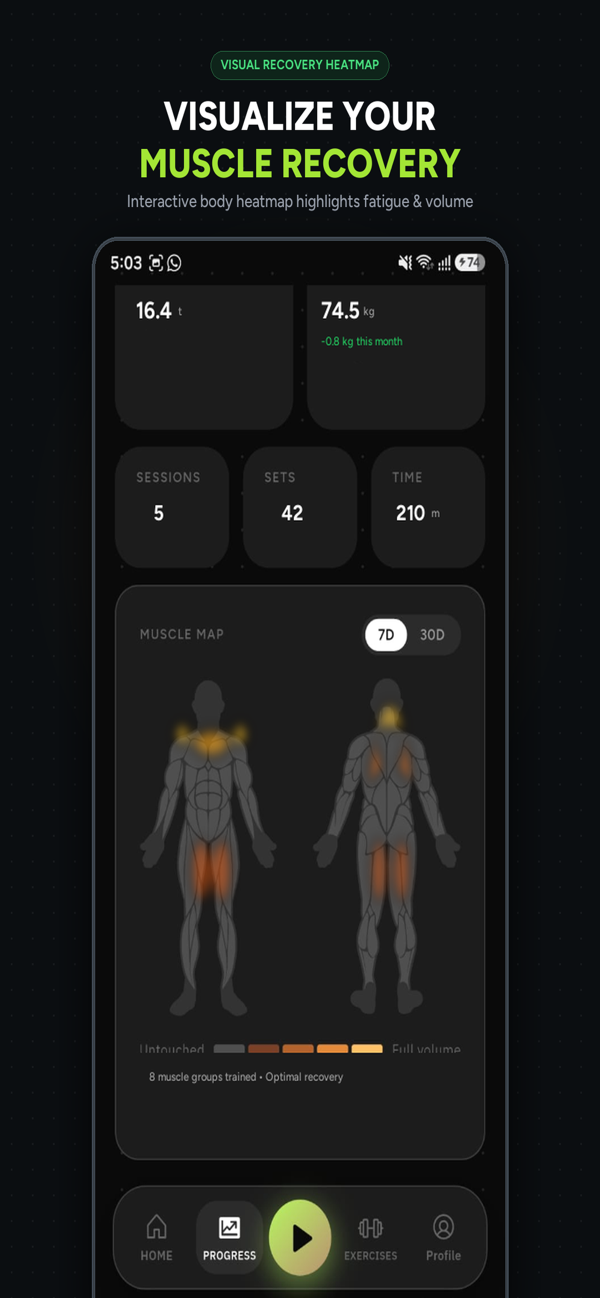
In GF Track, your weekly volume summary tallies this tonnage automatically and maps it onto the anatomical Muscle Recovery Heatmap, helping you ensure each muscle group receives sufficient cumulative mechanical stimulus to signal hypertrophy.
4. When to Deload
Progressive overload cannot continue linearly indefinitely. When you notice consecutive sessions where performance drops, joints ache, or RPE spikes on warm-up weights, schedule a planned deload week.
Reduce working sets by 40–50% or drop the load to 70% for one week to allow systemic recovery. Once refreshed, resume progression from your previous peak numbers.
Track these metrics in GF Track
Log sets, reps, and RPE with automated countdown rest timers and full on-device privacy.
Related Strength Guides
Hypertrophy Volume Landmarks: How Many Sets Per Muscle Group Per Week?
Understand Maintenance Volume (MV), Minimum Effective Volume (MEV), and Maximum Recoverable Volume (MRV) to optimize training sets.
How to Build a Consistent Workout Logging Habit That Sticks
Why most lifters abandon their workout logs after three weeks, and the simple behavioral strategies to make gym tracking effortless and permanent.
How to Structure a Push Pull Legs (PPL) Split for Maximum Strength & Size
A complete programming guide to organizing Push, Pull, and Leg workouts, exercise selection, weekly frequency, and volume balance.