
Visualize Your Muscle Recovery & Training Volume
Eliminate workout guesswork with an anatomical body heatmap. See exactly which muscle groups you've loaded, track cumulative volume over 7D and 30D, and program your splits with clarity.
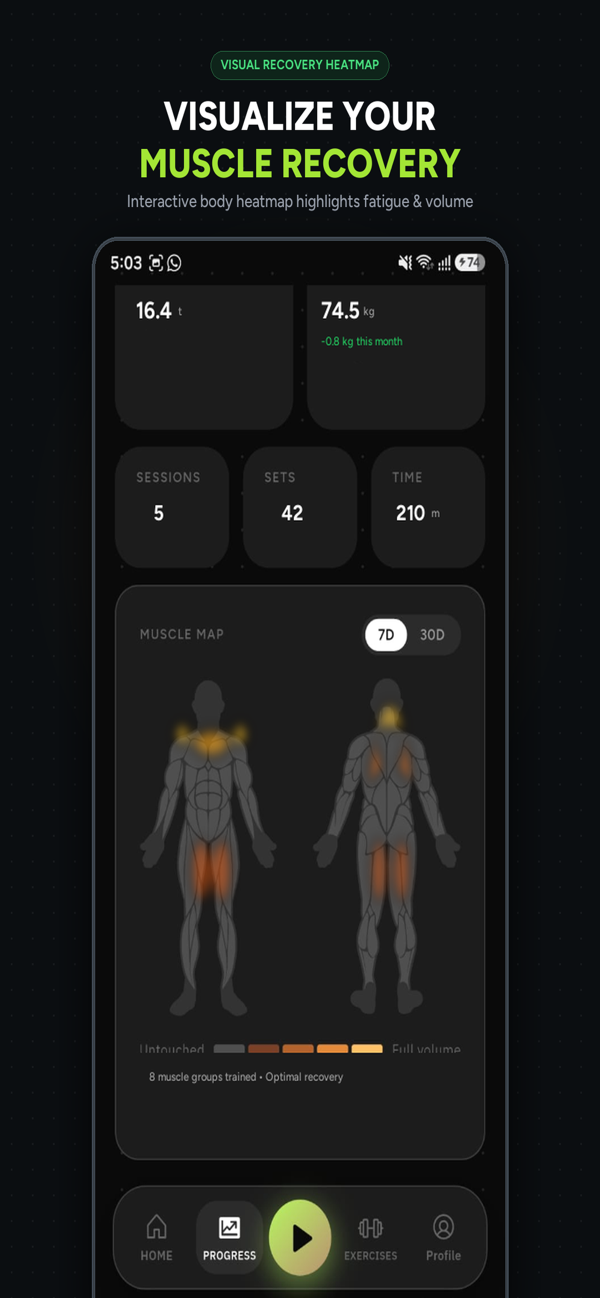
How Anatomical Heatmaps Improve Training Results
Lifting without volume tracking easily leads to chronic imbalance — overtraining front delts while neglecting rear delts, or under-training hamstrings compared to quads.
Untouched
Muscles that have received zero working sets in the selected window. These muscle groups are fully recovered and prime candidates for your next gym session.
Optimal Volume
Muscles that received moderate, productive stimulus (e.g. 10–16 weekly sets), hitting the sweet spot for hypertrophy and progressive strength gains.
Full Volume / Peak Stress
Muscles that have absorbed heavy recent tonnage. These areas should be given 48 to 72 hours of rest before undergoing intense compound loading again.
An Objective Tool for Mechanical Workload Tracking
GF Track's muscle recovery heatmap calculates mechanical training stress derived from completed workout sets, reps, and tonnage. It does not measure biological biomarkers, sleep quality, central nervous system fatigue, or medical conditions. Always listen to joint discomfort and physical fatigue when structuring your training.
Muscle Recovery Heatmap FAQ
How does GF Track calculate muscle recovery?
The recovery heatmap evaluates the working sets and total tonnage you recorded for each muscle group over the last 7 or 30 days. Muscles that received heavy recent volume are shaded with higher heat intensity, indicating high training stress, while unworked muscles remain cool, signifying they are fresh and ready for load.
Does GF Track diagnose injuries or measure biological readiness?
No. GF Track is a training log and volume visualization tool, not a medical or biometric diagnostic device. It maps mechanical training load based on your recorded sets to help you schedule balanced sessions and avoid neglecting specific muscle groups.
Can I toggle between short-term fatigue and long-term volume?
Yes. The interface features a 7D (7-Day) and 30D (30-Day) toggle at the top of the muscle map, allowing you to examine immediate acute fatigue or monthly cumulative hypertrophy stimulus.