
Hypertrophy Volume Landmarks: How Many Sets Per Muscle Group Per Week?
One of the most frequent questions lifters ask is: “How many sets do I actually need to do to build muscle?”
Do too few sets, and you will not provide sufficient stimulus for muscular hypertrophy. Do too many sets, and you cross into “junk volume”—accumulating systemic and joint fatigue without any additional muscle growth.
To program intelligently, sports scientists and strength coaches use Training Volume Landmarks.
1. The Four Key Volume Landmarks
Defined prominently by Dr. Mike Israetel and exercise physiology researchers, volume is measured in hard working sets per muscle group per week (sets taken within 0–3 RIR):
Maintenance Volume (MV)
The lowest number of working sets required to retain your current muscle mass.
- Typical range: ~6 sets per muscle group per week.
- When to use: During busy work periods, holidays, or when specializing in one muscle group while keeping others on maintenance.
Minimum Effective Volume (MEV)
The minimum volume required to produce noticeable, measurable muscle growth.
- Typical range: ~8 to 12 sets per muscle group per week.
- When to use: At the start of a new hypertrophy training block.
Maximum Adaptive Volume (MAV)
The optimal volume sweet spot where you experience the fastest rate of muscular hypertrophy.
- Typical range: ~12 to 20 sets per muscle group per week.
- When to use: The core working phase of your mesocycle.
Maximum Recoverable Volume (MRV)
The absolute ceiling of volume your body can recover from. Exceeding MRV results in performance regression, poor sleep, joint inflammation, and overtraining symptoms.
- Typical range: ~20 to 25+ sets per muscle group per week (highly dependent on individual genetics, sleep, and nutrition).
2. Typical Volume Landmarks by Muscle Group
| Muscle Group | Maintenance (MV) | Minimum Effective (MEV) | Maximum Adaptive (MAV) |
|---|---|---|---|
| Chest | 6 sets/wk | 10 sets/wk | 12–20 sets/wk |
| Back (Lats & Traps) | 8 sets/wk | 12 sets/wk | 14–22 sets/wk |
| Quadriceps | 6 sets/wk | 8 sets/wk | 12–18 sets/wk |
| Hamstrings | 4 sets/wk | 6 sets/wk | 10–16 sets/wk |
| Side Deltoids | 6 sets/wk | 8 sets/wk | 14–22 sets/wk |
| Biceps / Triceps | 4 sets/wk | 6 sets/wk | 10–16 sets/wk |
Note: Compound pulling movements (like rows) count toward bicep volume, and compound pressing movements (like bench press) count toward tricep and front delt volume.
3. How to Track Volume Landmarks in GF Track
Counting sets across a 7-day period manually across multiple workouts is error-prone.
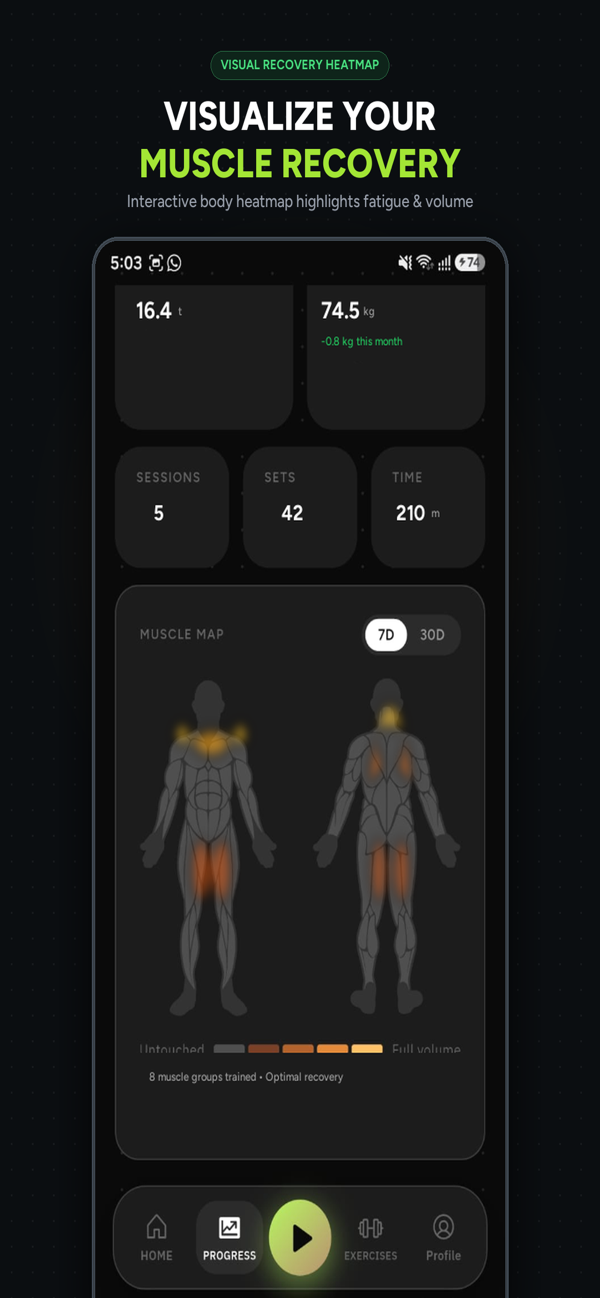
In GF Track, your Muscle Recovery Heatmap and weekly volume cards aggregate all working sets automatically by target muscle group. You can glance at your profile to see whether your chest has reached 14 sets this week, or whether your hamstrings are lagging at only 4 sets.
Use this objective visual data to adjust your remaining training days and maintain balanced, sustainable growth.
Track these metrics in GF Track
Log sets, reps, and RPE with automated countdown rest timers and full on-device privacy.
Related Strength Guides
How to Track Progressive Overload in Strength Training
A practical breakdown of progressive overload: understanding weight, volume, mechanical tension, and how to track strength progress over time.
How to Build a Consistent Workout Logging Habit That Sticks
Why most lifters abandon their workout logs after three weeks, and the simple behavioral strategies to make gym tracking effortless and permanent.
How to Structure a Push Pull Legs (PPL) Split for Maximum Strength & Size
A complete programming guide to organizing Push, Pull, and Leg workouts, exercise selection, weekly frequency, and volume balance.