
RPE vs RIR: How to Accurately Gauge Workout Intensity in the Gym
When following a strength training program, the weight on the bar is only half of the equation. Two lifters can both bench press 100kg for 8 reps, but if Lifter A completed the set smoothly with 3 reps left in the tank while Lifter B ground out the 8th rep to absolute muscular failure with blood vessels bulging, their physiological fatigue and recovery demands are completely different.
This is where RPE (Rate of Perceived Exertion) and RIR (Reps in Reserve) become essential tools in your workout tracking.
1. What is RIR (Reps in Reserve)?
RIR is the simplest and most intuitive way to measure proximity to muscular failure:
- 0 RIR: Absolute failure. You could not have completed another repetition with acceptable form.
- 1 RIR: You had exactly 1 rep left in reserve before failure.
- 2 RIR: You had 2 reps left before failure.
- 3 RIR: You had 3 reps left before failure.
For hypertrophy, the majority of research demonstrates that sets taken within 1 to 3 RIR stimulate nearly identical muscle protein synthesis as taking sets to 0 RIR, but generate drastically less central nervous system and joint fatigue.
2. What is the Borg / Tuchscherer RPE Scale?
Popularized in powerlifting by Mike Tuchscherer, the modified resistance training RPE scale directly mirrors RIR on a 1-to-10 numerical scale:
| RPE Value | Corresponding RIR | Description |
|---|---|---|
| RPE 10 | 0 RIR | Maximum effort; absolute failure. No reps remaining. |
| RPE 9.5 | Maybe 0 RIR | Could not do more reps, but could slightly increase load. |
| RPE 9 | 1 RIR | 1 rep remaining in the tank. Very heavy. |
| RPE 8.5 | 1–2 RIR | Definitely 1 rep remaining, maybe 2. |
| RPE 8 | 2 RIR | 2 reps remaining. Challenging working set. |
| RPE 7 | 3 RIR | 3 reps remaining. Bar moves with notable speed. |
| RPE 6 | 4 RIR | Speed / technique work. Minimal fatigue. |
3. Why Tracking RPE Enables Autoregulation
Life outside the gym fluctuates: poor sleep, work stress, minor dehydration, or caloric deficits impact your daily strength output.
If your program demands a fixed 120kg × 5 reps on squats every Monday:
- On a high-energy day, 120kg might only be RPE 6.5, meaning you under-stimulated your muscles.
- On a day with 4 hours of sleep, 120kg might become RPE 10, causing form breakdown and excessive fatigue that ruins the rest of your week.
By programming in terms of RPE (e.g. Squat 3 sets of 5 reps @ RPE 8), you adjust the barbell load to match your neurological capacity on that exact day.
4. How to Log RPE in GF Track
In GF Track, every working set includes an optional RPE field right alongside weight and reps.
When you complete your set, quickly ask yourself: “If a gun were to my head, how many more clean repetitions could I have ground out?”
Input that number into the app. Over time, review your logs to see if your strength at RPE 8 is increasing. When your previous 100kg @ RPE 8 becomes 100kg @ RPE 7, you have built genuine strength without having to grind to failure.
Track these metrics in GF Track
Log sets, reps, and RPE with automated countdown rest timers and full on-device privacy.
Related Strength Guides
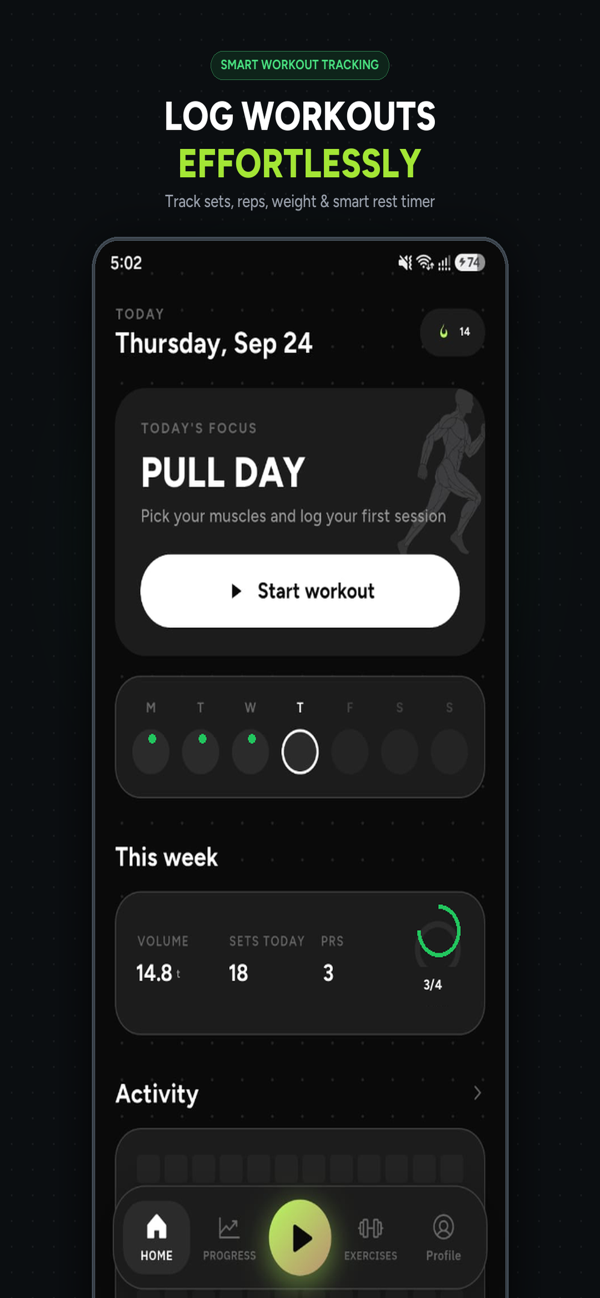
How to Track Your Gym Workouts Properly: A Guide for Lifters
Learn how to record sets, reps, weight, RPE, and rest intervals properly so your workout logs actually drive strength and hypertrophy progression.
How to Build a Consistent Workout Logging Habit That Sticks
Why most lifters abandon their workout logs after three weeks, and the simple behavioral strategies to make gym tracking effortless and permanent.
How to Structure a Push Pull Legs (PPL) Split for Maximum Strength & Size
A complete programming guide to organizing Push, Pull, and Leg workouts, exercise selection, weekly frequency, and volume balance.